Prologue

Mr. Dumfries grimaced as he pulled himself to his feet, his aching joints howling in protest.
“Reparo,” he growled, pointing his magic wand at what looked like a pile of ash. At once, the dust rose up into the air and swirled into a spinning mass of potsherds, which swiftly reassembled into the form of an ancient Mesopotamian urn, complete with seven-thousand-year-old cremated remains inside — or so Mr. Dumfries hoped, as he levitated the restored relic back upon its podium.
But further repairs would have to wait, reckoned the old night watchman, who — on the very eve of his retirement, after so many tranquil decades of quiet, uneventful service — had a real, honest-to-goodness emergency situation on his hands.
There was an unknown intruder in the museum — in his museum, the Museum of Magical History in Washington D.C.
The intruder, shrouded under a hooded black cloak, had caught Mr. Dumfries and his younger partner off-guard, Confunding them both as they drew their wands. In the resulting melee, the two befuddled wizards had shot stunning spells haphazardly in all directions, demolishing dozens of hallowed artifacts like a pair of rabid agropelters.
Young Mr. Fredericks, unencumbered by the effects of old age, had managed to shake off the Confundus Charm before Mr. Dumfries, whose rheumatism had been acting up for days, dulling his wits and rather souring his overall mood.
“Fredericks? You okay?” Mr. Dumfries called softly through the settling dust, scanning the wreckage for signs of life.
A low muffled groan emanated from the darkness in an adjoining room, and Mr. Dumfries, fragile heart racing in his chest, pointed his wand toward the doorway and hobbled hurriedly over the threshold.
“Lumos!” he said, and the tip of his wand illuminated. “Astringo!” he added, and the light focused itself into a narrow beam, which he cast about the darkened chamber, throwing shadows of statues and other standing objects onto far walls.
The beam of light swept over an amorphous mound on the floor, and Mr. Dumfries frowned at the sight of his partner, lying motionless on the ground. Rushing over to help his fallen comrade, Mr. Dumfries jumped suddenly sideways when a woman’s high voice rang out beside him.
“Hello! And welcome to the Wizards of the New World exhibit. My name is Isolt Steward, founder of the Ilvermorny School of Magic.”
Glaring at the animated bronze statue, which was talking blithely to nobody in particular, Mr. Dumfries knelt over his partner and found him to be breathing — magically immobilized, but thankfully alive and unhurt.
“In 1620, I became the first wizard settler — or rather, the first witch settler — to permanently emigrate from the Old World to the New, voyaging in secret amongst Muggle Pilgrims, aboard a ship called the Mayflower.” The statue gestured toward a large framed painting of an old wooden sailing ship, which bobbed along on the waves near a tree-lined shore. “As a young woman who was forced to leave her homeland, fleeing persecution, I knew next to nothing of the Americas, and I was quite unprepared for surviving in any wilderness, much less one so vast and unfamiliar.”
“Desino!” Mr. Dumfries grunted, pointing his wand at the statue, which froze and stopped talking at once. He aimed his wand at Mr. Fredericks, casting a pale glow over the younger man’s rigid form.
Then, from somewhere in the shadows, there came a small click, and the light from Mr. Dumfries’ wand went out, drenching the scene in sudden darkness.
“Lumos!” he said, trying to restart the wandlight, but nothing happened.
Touching the tip of his wand to Fredericks’ curse-bound body, he muttered a quiet counter-curse, but it failed to unbind him.
“What dark magic is this?” he growled, shaking his wand to test its power, and finding it to be somehow drained.
Then came several more clicks, and — one by one — all the dimmed wall lamps in a nearby corridor went out.
The hair on the back of Mr. Dumfries’ neck prickled as it stood on end. He felt around on the ground for his partner’s dropped wand. Upon finding it, he gave it a quick shake to see if it too had somehow been disabled by the mysterious Put Outer. To his relief, the wand emitted a few blue sparks.
Moving as quietly as he could, Mr. Dumfries stood and entered the dark corridor. He crept along its stretch of long velvety carpet, avoiding objects on display by memory, as he couldn’t see a thing to save his life. At the end of the corridor, he looked up at a sign, now invisible in the darkness, which he knew to say: The Philosophers’ Story: From Trismegistus to Flamel.
A few lights were still on inside the exhibit, and Mr. Dumfries strained to catch a glimpse of motion. When none appeared, he slipped a few paces into the chamber —but then he froze when something stirred in the shadows ahead. Mustering up all the courage he could summon, he pointed his partner’s wand in the direction of the stirring, then he cleared his throat so his voice wouldn’t crack.
“Ahem — Show yourself, burglar,” Mr. Dumfries bellowed. He paused, then, when nothing happened, he added, “I’m warning you: I’m armed.”
The thing stirred again, and the watchman shrieked, “Lumos! Astringo!”
A beam of light shot forth from the tip of his partner’s wand, illuminating . . . a cat — a big, fluffy black cat, with bright blue eyes, perched upon the head of a large stone statue of Bastet — the ancient alchemist and animagus once worshipped by Egyptian Muggles as a sort of feline goddess.
The cat stared down at Mr. Dumfries and made a little meow.
Momentarily nonplussed, the old night watchman just stared back for a second, cocking his head. But then there came another click, and the light from his partner’s wand went out, throwing everything back into total darkness once more.
“Petrificus Totalus!” said a voice from behind, and Mr. Dumfries felt his legs snap together, then he tipped over and fell flat on his back, arthritic joints screaming in pain, his entire body stiff as a board.
“I’m sorry,” his attacker whispered, stepping gingerly over his paralyzed form.
Flushed in anguish and fuming with anger, but with a face too frozen to frown, Mr. Dumfries very much doubted that.
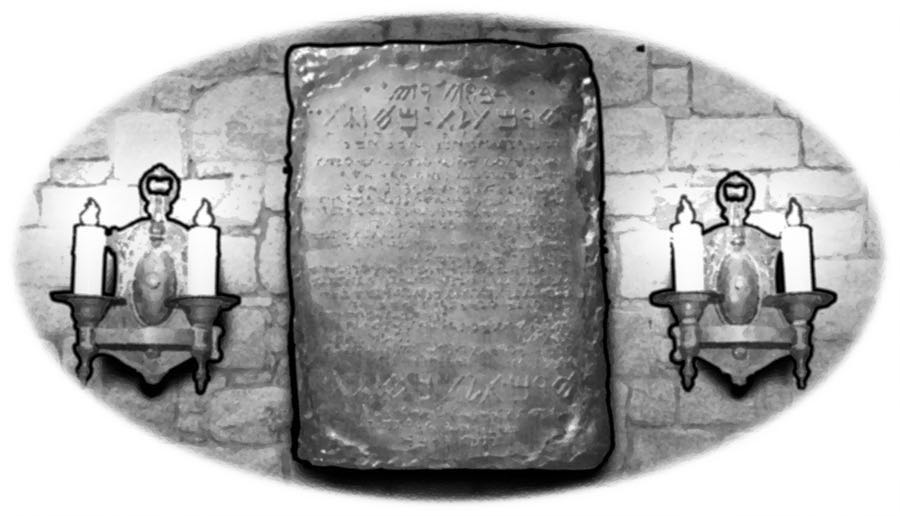
Paracelsus was deep in thought, contemplating the hallowed object on display across the hall. On loan from the Great Library of Alexandria, the ancient slab of green crystal, inscribed with arcane glyphs, had just arrived earlier that evening at the Museum of Magical History. A couple of chattering caretakers had brought it to the Seekers of the Stone exhibit, mounted it on the far wall, then gone home for the evening, leaving Paracelsus to gawk at the relic from afar ever since.
The legendary object was a masterpiece of antiquity — an item of such extraordinary power, it took the old man’s breath away. He had spent his entire life pondering it, poring over countless renderings and translations, trying to decipher its many layers of meaning. It was a wellspring of wisdom, a cornerstone of knowledge, the very foundation for his life’s greatest work. To finally witness the thing firsthand, after centuries of devotion, was a blessing beyond measure.
Spotlit from above, the artifact glowed in the darkness like a glorious ghostly gem. Paracelsus just could not take his eyes off it. Lost in thought, he didn’t notice the intruder creeping into the hall, and it came as quite a shock when he heard a little click, and the relic suddenly vanished.
The spotlight had gone out.
Paracelsus heard another click, and another nearby light went out. Three more clicks, and the entire scene was cast into darkness.
“Who goes there?” he said anxiously, and he shifted uneasily in his frame as the sound of footsteps approached, stopping right beneath his long hooked nose, which caught a whiff of dragon’s blood perfume.
“Langlock!” came a sharp whisper, and Paracelsus jumped. He would have cried out too, had his tongue not just glued itself to the roof of his mouth.
“Impedio effigy!” came a second hex, and the wall-bound old wizard, gagging as he fled, rebounded off the side of his frame and crumpled into a heap.
The footsteps patted away, and with another click, the spotlight across the hall flickered back to life. Then came the sound of a little puff of breath, and a small hooded figure appeared on the opposite side of the chamber, holding a smoldering candle in what appeared to be a shriveled severed hand.
The figure stashed the candle and its gruesome holder in an old leather satchel, then turned to face the object Paracelsus so revered, reaching up as if to take it. The old man whimpered helplessly as the burglar grasped the sacred relic and pulled it down from its mount. Plunder in hand, the robber turned, and Paracelsus strained to catch a better glimpse.
Even in daylight, his eyesight was poor. He was nearsighted and colorblind, and everything appeared to be a shade less than real, as if his window to the world was formed from a painter’s brushstrokes. And indeed it was, for Paracelsus was not in fact a man, but a portrait of a man, painted nearly five centuries prior — by a master, to be sure, but in a chamber rather short on light and rather long on ale. Cursing both his over-glazed eyes and his besotted artist for giving him such a shoddy point of view, he crawled forward and put his face right up to the canvas, which stank of hundred-year-old lacquer. And then, as if to accommodate the aged portrait’s shortcomings, the thief drew back her hood.
Paracelsus recognized her at once from her long white hair, which was shockingly pale, all traces of color having long since vanished, despite her relative youth. Her deceivingly girlish face was as pale as a ghost’s, its finer features obscured beneath a spiderweb of dark tattoos. Her thin lips, painted black as usual, were curled up into a triumphant smirk. Her fiendish yellow eyes smoldered behind inky curtains of long, thick lashes — and one of them winked.
The rogue witch held the old man’s flustered gaze for a few excruciating seconds. Then, with a haughty nod, Mulcedra — Lady of the Shadows, the infamous sorceress and mysterious mistress of He-Who-Must-Neither-Be-Named — tucked the Emerald Tablet inside her satchel, spun on her heel and vanished.
Two thousand and then-some miles west, a flustered cemetery caretaker stood on the edge of a thirty-foot crater, surveying the gruesome scene around him.
The carnage was almost beyond belief. Bathed in the harsh white glow of a dozen giant floodlamps, all the severed limbs, decapitated heads and other bits of human remains were mixed amongst the rubble of dirt, rocks, splintered coffins and shattered gravestones.
Of course, it was some small consolation, knowing all these people had already been dead — some for many decades — prior to being blown to smithereens. But that was beside the point. Mr. Lindo couldn’t think of a worse form of desecration for anyone’s place of rest, let alone so many.
And there must have been dozens!
How on earth had that poor little girl survived?
After the deafening, ground-shaking explosion had drawn him to the scene, he had found her at the center of the crater — unconscious and badly hurt, but somehow still in one piece. Naturally, his first order of business had been to call 9-1-1 and see the young girl to safety. Once the ambulance had carted her off however, he’d taken a moment to soak it all in, and his second order of business had become quite clear.
As the cemetery’s caretaker, it was his job to start sifting through the rubble as soon as possible, putting everything (and everyone) back in order. But the police had cordoned off the area with yellow tape, and the woman in charge of the investigation had promptly barred him from crossing that line. And so he’d sat, twiddling his thumbs ever since, growing ever more impatient with every passing minute.
Soon enough however, he was back on his feet, conjuring up the nerve to complain, resolutely considering his duty to clean up the horrible, horrible mess before him. He owed it to all these people: the dishonored dead. It was more than just his job as caretaker, it was his responsibility as a moral and upright human being.
The solemn thought prompted Mr. Lindo to gaze up into the night sky, which prompted him to blink in astonishment. As if the bizarre scene on the ground wasn’t extraordinary enough, there were also several peculiar things going on high above that just weren’t normal. He had never seen so many shooting stars in all his sixty-seven years on earth, nor had he ever seen so many birds flying about in the dead of night.
As fiery multicolored meteors rocketed about in all directions high above, dozens of winged creatures flew hither and thither, faintly illuminated by light escaping from the floodlamps on the ground. The owls perhaps weren’t so surprising, given that they are nocturnal, but to see so many at once?
And the owls were nothing compared to all the other birds of prey soaring above — hawks, falcons, eagles and more — many, many birds that Mr. Lindo knew were not nocturnal, nor would he ever expect to see them in such numbers, even during the daytime. Marveling at the strange aerial display above his head, he could just make out the distinctive white crest of a great bald eagle, which seemed to be circling the area.
The eagle, whose name was Migizi, saw Mr. Lindo watching her and decided it was time to move on. She’d been sidetracked for a few minutes, flying past the graveyard where a most extraordinary event had occurred only but an hour or so ago. That particular event — whatever it was — had culminated in an incident— an incident so incredible, so fortunate and so utterly unexpected that it was, in fact, the sole reason for Migizi’s current mission. Indeed, it was the reason for the entire flurry of activity now taking place all around her.
Dangling from Migizi’s left leg was a leather tube case, which contained a small roll of parchment — a brief letter, written by a person she didn’t know. The note had been scrawled as if in haste:
Blackwell,
Fleeing to Mexico with Rath. Find us in Oaxaca, if you can.
Wolfe
P.S. Remember Voldemort once cheated death — may Morgod also rise again!
Messenger birds are almost never privy to the letters they carry, and this one was no exception. Had Migizi known about the person who wrote the note or their purpose in writing it, she might have seen fit to “accidentally” drop her charge somewhere in the middle of the desert — although to do so would be a gross violation of Post Office policy. Thus, without any further delay, she continued along with her mission.
It was hard to fly at night. Normally, she worked during daylight hours, along with all the other diurnal messenger birds. But many of them, like her, were now being pressed into temporary overnight service. The sheer volume of notes and letters to deliver was just so high, there simply weren’t enough owls to keep up with demand. In the past half hour, she had avoided near collisions with several fellow eagles, hawks and other tired half-blind coworkers.
On she went, gliding over a sprawling stretch of sleepy houses, a quiet church, an empty shopping mall, a darkened office complex. One large building in the distance stood out among the others, having a fair number of lit windows for such a late hour. Training her sharp eyes on the light source, Migizi peered through one of the windows and spied the face of a young girl — one she recognized in an instant, despite being over a mile away. (Eagles, of course, have very good eyesight!)
As much as she wanted to linger and witness the girl’s immediate destiny from afar, Migizi forced herself to press on, having already dawdled a bit too long, circling that battered old graveyard. She — and the rest of the world — would find out soon enough what fate had in store for the girl . . . and with any luck, it would be something very unpleasant.